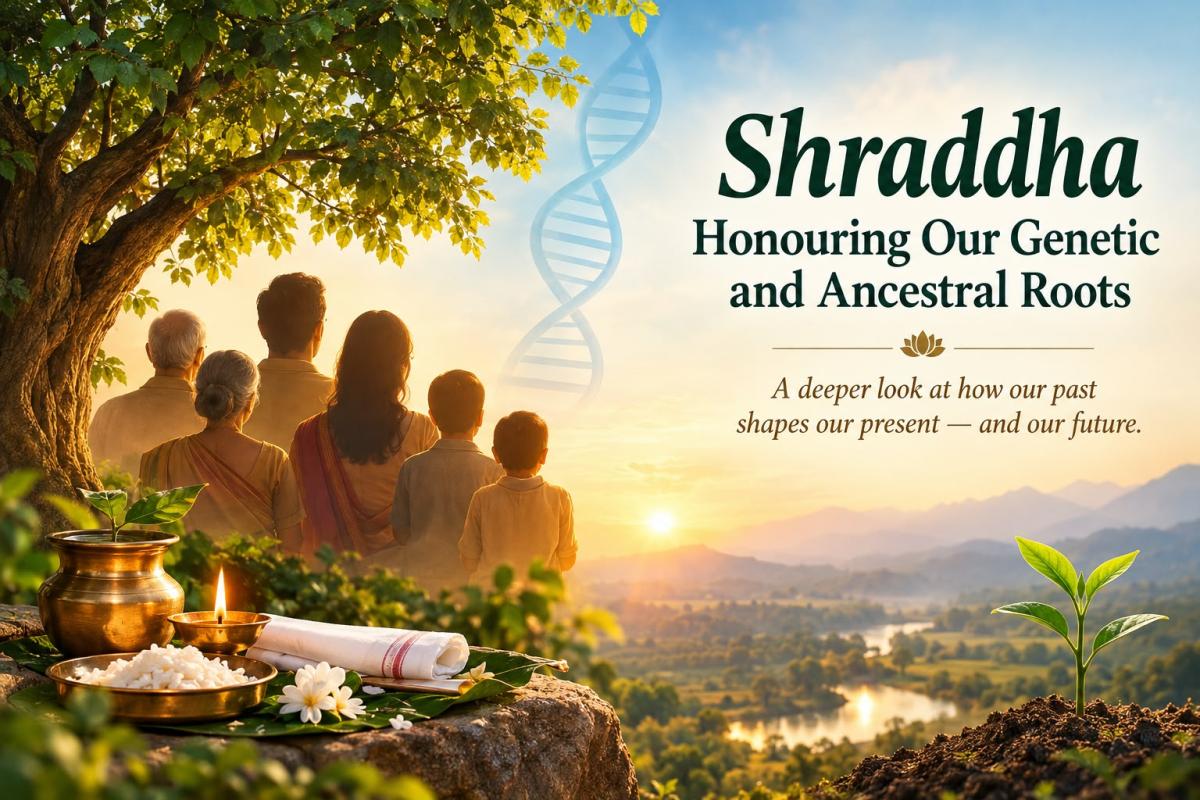
The ceremony of Shraddha is often understood merely as a ritual performed for deceased ancestors. In a literal interpretation, it can appear as though a departed soul is somewhere waiting for food, water, offerings, or prayers from its descendants. But the deeper meaning of Shraddha can be understood very differently.
At its heart, Shraddha is an act of acknowledgement, gratitude and remembrance.
It reminds us that the person we call “I” did not come into existence independently. Before we became individuals with our own names, personalities, ambitions and identities, there was an enormous chain of biological and cultural continuity that made our existence possible.
We inherited our bodies from our ancestors.
Our genes came through them. Our physical characteristics, genetic predispositions and many aspects of our biological constitution are connected to generations that existed before us. But inheritance does not stop at biology.
We also inherit a language, a culture, traditions, family structures, social circumstances, values, beliefs and patterns of behaviour. We may inherit privileges as well as limitations. We may grow up with family fears, habits, expectations and unresolved patterns that existed long before we were born.
We did not consciously choose most of these things.
And yet they form the starting point from which we construct our lives.
The illusion of the completely independent individual
Modern life often encourages us to think of ourselves as completely independent individuals.
We say:
“This is my life. These are my achievements. I made myself.”
But how much of the foundation on which we stand did we actually create?
Did we choose our genes?
Did we choose our parents?
Did we choose the language we first heard?
Did we choose the family into which we were born?
Did we choose our childhood environment, our initial economic circumstances, our culture or many of the beliefs that were introduced to us before we were old enough to question them?
The answer to most of these questions is no.
Our individual journey begins on a foundation that existed before us.
That foundation is our ancestral inheritance.
This does not mean that we are prisoners of our ancestry. Nor does it mean that everything our ancestors believed or did was correct. It simply means that our starting point was created partly by circumstances that preceded us.
And this is where the deeper significance of Shraddha emerges.
Shraddha is an acknowledgement of continuity
The Sanskrit word Shraddha is associated with श्रद्धा—faith, reverence and heartfelt acknowledgement.
The ceremony therefore need not be understood merely as an attempt to communicate with a deceased individual.
It can also be understood as an acknowledgement of the continuity of life.
We are one link in a chain that stretches backwards through countless generations.
Our ancestors lived, struggled, adapted, made decisions, raised families and eventually passed away. Their genetic material continued through their descendants. Their culture, knowledge and experiences were transmitted in different forms. Their choices influenced the circumstances into which subsequent generations were born.
We are therefore not isolated events.
We are part of a continuum.
Shraddha creates a conscious moment in which we pause and acknowledge that continuum.
What does “Pitru” really mean?
The word Pitru is often reduced to the idea of a deceased ancestor. But conceptually, it can be understood more broadly as representing the ancestral past that continues to have a relationship with our present.
Your ancestors may no longer physically exist, but their consequences exist.
Their genes exist in you.
Their descendants exist.
Their decisions may have influenced the circumstances of your family.
Their culture may have become part of yours.
Their successes may have created opportunities for later generations.
Their mistakes may have created challenges that later generations must understand and overcome.
Their memories may exist in family stories.
Their values may appear in your behaviour.
In that sense, the past is not actually completely past.
The past survives in the present.
This is one profound way of understanding the concept of Pitru.
Genetic roots and the modern understanding of inheritance
Science gives us a useful framework for appreciating this continuity.
Human beings inherit genetic material from their parents, and that genetic material is the result of an enormously long biological history.
Each generation passes DNA to the next, with recombination and variation creating differences between individuals. Consequently, every person carries a biological connection to generations of ancestors.
At the same time, genetics does not determine everything about who we become.
Environment, nutrition, education, relationships, socioeconomic conditions, culture and individual choices all interact with biology.
There is also scientific research into epigenetic mechanisms, through which environmental factors can influence gene regulation. However, epigenetics is sometimes overstated in popular discussions. It should not be presented as scientific proof that specific memories, behaviours or “karma” are directly transmitted from ancestors. The scientific evidence is considerably more nuanced.
The spiritual concept of ancestral influence and the scientific study of inheritance therefore belong to different explanatory frameworks.
They can be placed in conversation with one another, but they should not be treated as identical.
The mango seed and its field
Consider a mango seed.
The seed contains the biological potential to become a mango tree. But the seed cannot fulfil that potential in isolation.
It requires soil, water, sunlight, temperature and an appropriate environment.
Similarly, a human being may possess enormous individual potential, but that potential unfolds within a particular field of experience.
That field includes family, culture, geography, economics, education, relationships and society.
Our ancestral lineage is one of the important elements that helps create this initial field.
This does not mean that our destiny is permanently fixed by our ancestors.
A seed can encounter different conditions and develop differently.
Likewise, a person can consciously transform inherited patterns.
And this may be one of the most meaningful ways to understand Pitru Rina—the ancestral debt.
It need not mean lifelong guilt or blind obedience to ancestors.
It can mean recognising:
“I received something before I could give anything.”
Ancestral debt is not blind obligation
There is an important distinction between gratitude and indebtedness.
Honouring our ancestors does not require us to believe that everything they did was right.
Every family has strengths and weaknesses.
Every generation inherits both wisdom and mistakes.
Some traditions deserve preservation.
Some patterns deserve transformation.
Some beliefs may have helped an earlier generation survive but may no longer be appropriate for the present.
Therefore, acknowledging our ancestors does not mean repeating them.
In fact, one of the deepest forms of respect may be to end a harmful pattern rather than pass it forward.
If an ancestor struggled with fear, we can learn courage.
If a family carried unresolved conflict, we can develop healthier communication.
If previous generations lacked opportunities for education, we can use our opportunities responsibly.
If we inherited privilege, we can use it constructively.
If we inherited limitations, we can work consciously to overcome them.
In this sense, ancestral gratitude becomes an active responsibility rather than a passive ritual.
Why perform Shraddha when the ancestor may have been reborn?
This is one of the most common philosophical questions.
If the deceased person has already taken another birth, who receives the Shraddha?
The answer depends upon the philosophical framework one follows.
Within traditional Hindu thought, concepts such as rebirth, karma, Pitru-loka and ancestral rites have different interpretations across texts and traditions. There is therefore no need to reduce the entire ceremony to the proposition that an individual soul is literally sitting somewhere waiting for food.
Shraddha can also be understood symbolically and psychologically.
Even if an ancestor is no longer an individual presence in the form we remember, the ancestral relationship has not become meaningless.
The genetic inheritance remains.
The family continuity remains.
The consequences of their lives remain.
The memories remain.
The cultural inheritance remains.
And the responsibility toward future generations remains.
Thus, the ceremony can have meaning even when understood beyond a literal interpretation of an ancestor receiving the offering.
Shraddha as a dialogue between three generations
Perhaps the most beautiful way to understand Shraddha is as a relationship between three generations:
Those who came before us.
Those who are living now.
Those who will come after us.
The first generation gave us a foundation.
The present generation receives, evaluates and transforms that foundation.
The next generation receives what we leave behind.
This makes Shraddha not merely a ceremony about death.
It becomes a ceremony about continuity.
When we remember our ancestors, we are also reminded that one day we too will become ancestors.
The question therefore changes from:
“What do my ancestors owe me?”
to:
“What have I received from those before me, and what will I leave for those who come after me?”
That is a much deeper question.
From inherited patterns to conscious evolution
Every generation has an opportunity to improve upon what it inherited.
We cannot change the past.
But we can change what the past becomes in the future.
We cannot choose our genetic roots.
But we can choose how we live with them.
We cannot rewrite our childhood.
But we can decide which patterns we carry forward and which ones end with us.
We cannot alter the decisions of our ancestors.
But we can give meaning to their struggles by using our own lives constructively.
This transforms the idea of ancestral debt.
The greatest repayment to our ancestors may not be ritual alone. It may be conscious living.
To preserve what was valuable.
To correct what was harmful.
To heal what was wounded.
To transmit wisdom.
To create better circumstances for the next generation.
And ultimately, to leave behind a healthier inheritance than the one we received.
The deeper purpose of Shraddha
Seen in this light, Shraddha becomes much more than an annual ritual.
It is a moment of humility.
It reminds us that our existence did not begin with us.
It reminds us that our body carries biological history.
Our mind develops within a social and cultural history.
Our family carries memories and patterns from previous generations.
And our choices will influence generations that we may never meet.
Shraddha therefore connects biology, memory, family, culture, spirituality and responsibility.
It tells us:
You are an individual, but you did not create yourself.
You are the continuation of something much older than your individual identity.
And while you are not responsible for everything you inherited, you are responsible for what you choose to do with it.
Perhaps that is the deepest meaning of honouring our genetic and ancestral roots.
We bow to the past—not because we must repeat it, but because we acknowledge that without it, we would not be here.
And then we turn toward the future, carrying forward the best of what we received and consciously transforming what needs to change.
That is the spirit of Shraddha.